Solomon Education Solutions

  • Home
  • About Us
  • Vision
  • Library
  • Support
  • Contact Us


Community Tourism


Tourism, one of worlds’ largest industries, and promises to breathe new economic life into many Colombian communities.  As changing economic conditions have raised concerns in traditional agricultural and industries, departmental, and local leaders as a vehicle for economic change have targeted tourism.  Like many places around the world many Colombian communities, rural and urban alike are considering tourism as a way to revitalize, stabilize, and diversify their economies.  They recognize that successful tourism development in other communities has generated new income, jobs, and tax revenues.


Tourists' expenditures filter through communities to create a chain of economic and social action.  Some tourism jobs are filled by young people and other traditionally disadvantaged labor markets.  Tax revenues generated by tourists' expenditures can contribute to supporting public facilities and services that a community might not otherwise afford.  Playing host to "guests" often fosters a sense of community identity and pride.


This publication has been prepared to help you consider and initiate tourism development within your community.  Five purposes were kept in mind:


SECTION 1..  To introduce tourism as an emerging industry in Colombia and as a strategy for economic development.

Section I presents some basic facts about tourism and provides important tourism definitions.


SECTION  2. To help you understand how tourism functions as a system of interconnected parts  attractions, services, transportation, communication, and markets.

These parts together create tourism "products," (i.e. mixtures of experiences and benefits) that tourists receive.  Section II will help you to understand the tourism system and the ways those community tourism products can be developed and marketed to select tourist markets. 


SECTION 3. To assist you in evaluating tourism as an economic development alternative that addresses community needs.

The benefits that tourism delivers should be compared with your community's specific needs to determine if it is an appropriate economic development alternative.  Section III of this publication will help you evaluate the potential benefits and costs of tourism development in your town.


SECTION 4. To present a planning process for tourism development that will help you establish tourism goals, assess, and build upon your community's special characteristics to achieve these goals.

While every community has its own unique attributes, general guidelines for tourism planning are applicable to all.  Section IV of this publication outlines the steps of the tourism planning process.  Worksheets are provided to help you apply the process to your community’s location, leadership, financial capabilities, and markets.  


SECTION 5. To assist you in identifying important tourism networks that can complement your efforts.

Networking involves linking with other agencies and organizations to maximize efforts, share ideas and approaches, and learn from the experience and perspective of others.  Networking is vital to effective community, regional, and statewide development.  Individuals and organizations that represent each of these areas should be part of your tourism network.  The companion publication Sources of Assistance for Tourism in Texas identifies organizations that will help to meet your ongoing tourism information needs.


Who Is This Publication For?

This publication has been prepared for business and community leaders within governmental, commercial, and non-profit organizations.  These leaders include:


• councils of government, elected officials, and public administrators

• chambers of commerce, and convention and visitors bureaus

• tourism-related business owners and managers

• concerned citizens

• local and regional planners, and economic development officials


While many of the concepts, issues, and processes described within this manual will help individual organizations and businesses to more effectively respond to tourism, this publication has been prepared with a community approach in mind.  That is, it focuses on the cooperation between public, commercial, and non-profit interests to achieve tourism benefits for an entire communityrather than just a single organization or enterprise.  Processes and methods for gathering resident support and involvement are included as a key aspect for ensuring that tourism development contributes to the well being of those who host the visitors in their town and regions.  Special emphasis has been placed on assisting smaller Texas communities.  However, the concepts, issues, and processes presented here are relevant to communities of any size or location.  The focus of this publication is on the development of pleasure travel in your community, although the same process is appropriate for business travel markets.


Tourism: An Emerging Industry


Tourism, now recognized as one of the world's major economic and social activities, and has been estimated to be the largest industry throughout the world.


Billions more dollars are spent on short haul and leisure trips.  Most states, and many communitieslarge and small, rural and urbanhave recognized the economic benefits of capturing a portion of these travel expenditures.  In Texas, the role of tourism is significant and increasing each year.


Defining Tourism And Tourists


The term tourism once described only travel undertaken for vacation or leisure purposes.  Today, the travel industry defines tourism to include both pleasure and business travel.  Because of the tendency to equate tourism with only pleasure travel, the industry has further adopted travel industry as the preferred terminology because of its more inclusive connotation.  Over the years, there have been considerable discussions regarding the definitions of tourist and tourism industry.  In practice, most differences in these definitions relate to the distance that one must travel to be considered a tourist.


The main reason for using the minimum distance criteria (50 or 100 miles) is to exclude routine travel of local residents.  For the purpose of this publication tourist and tourism industry are broadly defined as:


• A tourist in the United States is anyone traveling 50 miles outside his or her community of residence to engage in activities which are not a part of the person's regular routine of activity, such as to work or school.11

• The tourism industry is considered as all businesses, organizations, governmental bodies, and their related facilities, lands and services that accommodate the needs of travelers.12


From a community perspective, one can easily see that tourism involves many different businessfood and beverage, transportation, attractions, retail, lodgingas well as the services and facilities of public and non-profit agencies and organizations.  The degree to which a business or a public facility supports travelers will vary, as does the importance of tourism from community to community.


Foundations Of Community Tourism


Virtually every town and city now receives visitors of some kind.  Therefore, tourism is already a part of their local economy.  Some communities are naturally endowed with superior qualities for attracting tourists.  However, by understanding the requirements of the travel industry most communities can be more effective in their tourism efforts.


What Can Tourism Do For Your Community?

Tourism successes do not just happen.  Built upon an understanding of the tourism system, successful programs are the results of careful planning, management, and marketing.


The three basic elements of tourism are:


1. community (its people, services, businesses and industry)

2. attractions and events (things to do and see for visitors)

3. tourist markets (the people who travel to your community)

The challenge of developing community tourism is to systematically assess each of these elements and create strategies that are most likely to achieve your community tourism goals.  Central to this assessment and the management of tourism is organization.


The decision to launch into a program to expand tourism development should be based on the ability of tourism to produce the desired outcomes or goals sought by the community.  Early on, specific goals should be stated which guide your community tourism efforts.  Defining community goals and developing tourism strategies are addressed in detail later in Sections III and IV.


Tourism may help some communities meet a variety of developmental needs.  For example, tourism can:


• create opportunities for employment, especially underutilized  resources 

• increase revenues for local businesses and industry

• generate tax revenues

• increase stability by broadening the economic base

• reduce seasonal variations in revenues

• increase leisure opportunities for residents

• make the community more attractive


These benefits of tourism development are not without costs.  Section II discusses how to evaluate tourism goals and Section III discusses some of the costs of tourism development (See Table 2, Section III).


Balancing Benefits and Costs: Sustainable Tourism

Tourism development in the community should consider both the costs and benefits of tourism.  This will ensure that the destination’s resources are sustainable over the long-term.  The concepts of sustainable development and sustainable tourism are often used in development related issues. Sustainability in tourism relates to both hosts and guests, as well as social, cultural, environmental, political and economic aspects of tourism planning and development.  As defined by the World Tourism Organization, (Agenda 21 for the Travel and Tourism Industry, p. 30): 


Sustainable tourism development meets the needs of present tourists and host regions while protecting and enhancing opportunity for the future.  It is envisaged as leading to management of all resources in such a way that economic, social, and aesthetic needs can be fulfilled while maintaining cultural integrity, essential ecological processes, biological diversity, and life support systems.

For the local residents, tourism development impacts on their community’s economic, social, and cultural aspects, while directly affecting their quality of life.  Adverse effects of tourism development on the integrity of the natural habitat surrounding a destination can affect the ecological integrity and the lifestyle which residents may wish to experience in that locality.  Hence, it is critical to understand the nature of the tourism product, and the way tourism functions, if the benefits of tourism are to be gained and shared equitably among the destination’s many varied stakeholders, including the visitors and the residents of the host community or region.  This is discussed next, in Section II. 


It is important to remember that tourism is just one means of diversifying the community’s economic base, and therefore a careful analysis of the community’s overall economic and social situation is required as a first step in examining the potential for tourism as a tool for economic development.  Thus tourism has to fit into the overall planning and development goals and objectives of the community, so that it contributes to improving the well being of the local residents and does not degrade the environmental and cultural resources of the destination community.  A number of principles can be employed to ensure that the benefits of tourism are distributed fairly among the destination’s stakeholders, including the residents who often bear the costs of tourism development.  These principles include, but are not limited to the following:


a.) Involve a broad spectrum of the destination’s stakeholders in the planning and development of tourism in the community.  A stakeholder here is one who is impacted by tourism in the community, or one who has the potential to affect the development and planning of tourism in the destination.  Cooperation and partnerships are important to enable the community to finance and market the destination’s attractions and also to manage the multiple impacts of tourism.


b.) Ensure that the benefits of tourism development are distributed equitably both in the short-term and long-term.  Hence, the use and distribution of tourism related resources should be such that these are preserved not only for the benefit of present generations but also future generations of residents and visitors.


c.) Provide a high quality visitor experience while implementing sound environmental and cultural / heritage management practices, in order to manage the impacts of visitation on the destination’s resources (which may be renewable and non-renewable ones). 


d.) Create opportunities for meaningful local employment and involvement in the tourism industry.  Residents should be able to participate in controlling and making decisions about tourism in their community.  They should also be involved in tourism practices involving the marketing and interpretation of local cultural and heritage attractions and events.


SectionII 

How Does Tourism Function


Two functions of tourism most understood are promotion and accommodations.  The first action frequently taken by communities embarking on a tourism development program is to raise money for promotion.  The most conspicuous evidence of tourism in any community is the lodging facilities.  Tourism, however, encompasses more than just promotion and accommodations, even as essential as they are.  This section looks at five important topics that provide a foundation for understanding, considering, and building tourism in your community.  


These topics are:


1. the market-destination principle

2. understanding and identifying target markets:  the reasons people travel

3. components of successful leisure destinations:  what your community has to offer people

4. the tourism system:  the link between markets and destinations

5. conditions for effective tourism development


The Market-Destination Principle


All businesses have two important dimensions, markets, and products.  This is certainly true, in principle, for tourism.  Tourism differs, however, from industries such as manufacturing, because tourism moves markets to products, whereas manufacturing distributes its products to markets (see Figure1). This means that the “production,” marketing and consumption of tourism are inseparable from each other or from the destination. 


• Tourism products are found in destinations  (areas containing the attractions and services that provide tourism experiences and benefits to visitors).  The product of tourism is the "experience package."  It has been described as a mix of products and services.

• Travel markets represent those people willing and able to spend their time and money to receive those common experiences and benefits.

Unless markets (the consumers) know about the tourism products you have available, they will not make your community their travel destination.  In addition, a community and its surrounding area must offer tourism attractions and services (products) that are in demand by a travel market.  No amount of promotion will attract disinterested visitors.  For this reason, those concerned with developing tourism must become very knowledgeable about the basic tourist flow and its two dimensions (the characteristics of their community that make it a unique and desirable place to visit, and those travel markets to which they can best appeal).


Understanding and Identifying Target Markets


It is impossible for your community to be all things to all tourists.  Successful tourism development depends upon aiming your efforts at target markets, which is, taking a rifle approach rather than a shotgun approach.  A rifle approach increases chance of scoring a direct hit, that is, being a great success with particular target markets.  One of the best ways to develop and market your tourism destination is to appeal to specific market segments and target markets.  The objective is to focus only on the needs and preferences sought by an identifiable set of visitors.  Remember that there are many motivations to travel each representing an individual market.  For example:


• to visit friends and family

• to conduct business in another town

• to attend conventions, festivals and special events

• to attend to personal needs, such as that related to health

• to go shopping

• to engage in outdoor recreation activities

• to experience places of historical or scenic value


Market Segmentation

As this list suggests, people travel for many different reasons.  These different groups are called market segments.  Market segmentation, the process of breaking the total travel market into smaller, more uniform groups, is one of the basic principles of tourism development and marketing.  It recognizes that both business and pleasure travel markets have several separate segments, each with a unique set of needs and preferences.


How do you divide your market into segments?  One common method is by geographic areas.  In other words, where do your visitors come from?  What cities, states, regions, or countries generate the greatest number of visitors?


By defining markets into segments one can better understand whom, when, how, and why people travel to your community.  Without further definition, this data reveals little more than a clue for developing tourism.  For this reason, it is necessary to identify other ways to further define markets into segments.  In total, there are seven general approaches you can use:


1. purpose of trip

2. geographic origin of visitors

3. socio-economic or demographic characteristics

4. product-related

5. psychographic profiles

6. frequency and seasonality of use

7. channels of distribution


Each of these segmentation methods are further defined in Table 6 (Section IV).  By combining these methods, you can more accurately begin to zero-in on your community's target markets.  These often can be further described by: time of year for trips, amount of expenditures, frequency of visits, accommodation types, trip characteristics (length of stay, etc.), outdoor recreation activities, and demographics (ethnicity, income, age, gender, etc.)


While these descriptions help to identify the many types of tourists that are important to your area, they do not sufficiently explain what pushes or motivates people to engage in travel in the first place.  An understanding of those motivations that tourists wish to satisfy through travel is critical to the development and marketing of any tourism destination.


The key to understanding tourists' motivations is to see travel as a satisfier of needs and wants.  These needs and wants refer to much deeper personal concerns than the reasons usually given by people when asked, "Why do you travel?"  For example, tourists do not take trips just to engage in recreational activities such as fishing.  They take such trips with the hope that the travel experience will provide an escape from routine, physical relaxation, and perhaps the opportunity to make new friendships.


Why is it important to understand motivations such as these?  Once you understand tourists needs and wants your community will be better prepared to satisfy them.  Segmenting travel markets, as described above, provides a means of zeroing in on specific needs and wants.


Motivations For Pleasure Travel

The primary motive that drives all pleasure travel is the need for change.14 This often means the need to escape the routine, to explore new environments and to enjoy novel situations.  Beyond this primary motive, people are pushed to travel by a variety of needs and wants.  If motivations were the same for everyone, many of us would travel to the same destinations, do the same things, stay at the same types of hotels, and use the same kinds of transportation.  Since this is not the case, differences in motivation help to define distinct travel markets to which different tourism destinations can be marketed.


The following are some common motivations for travel.  Most travel is driven by the need to satisfy a combination of needs and wants, some of which may not be recognized by travelers themselves.  As you read through this list, consider which combinations of motivations your community could easily and effectively satisfy.


Escape from Routine and Responsibility: While a temporary change in environment characterizes all travel, people often seek changes of other kinds.  These may include a change in daily routine, a change in social group, or a change in leisure or work activities.


Relaxation:  In everyday life, the term relaxation usually means physical rest.  In a tourism context, however, relaxation often means taking time to pursue activities of interest.  For tourists, engaging in physical activities often results in mental relaxation.


Regression:  When people are comfortable they often feel freer to engage in behavior that they may not participate in at home.  Hence, the need to "regress" or do things outside of everyday life drives some to travel.


Status and Prestige: Many people travel for recognition, attention, and appreciation.  Certainly some destinations are more prestigious than others are and these will attract those tourists for whom status is a primary motive.


Family and Friend Togetherness: Family and friend considerations are an important travel motivation.  The majority of all trips are taken to visit with family and friends in their home communities.  Besides these visits, many people see the opportunity to travel and vacation as a family or friend group as a way to bring members closer together.


Meet New People: The desire to meet new people are satisfied by people-oriented trips, as opposed to place-oriented.  Meeting new people means different things to different individuals.  It can mean briefly meeting people from different backgrounds (something that occurs more easily while away from home), developing permanent new friendships, or interacting with local people.


Self-Discovery:  Many people find that travel experiences help them to learn more about themselves.  When traveling, people have the opportunity to learn how they react to new situations, such as meeting new people, overcoming hardships, and observing different cultures.


Education:  A strong motive for travel is the desire to learn about a place, a historical period, or another culture.  The education that travels provide is seen by many as a means for developing a well-rounded individual.  For this reason, family travel is often undertaken for educational purposes (as well as the motive of family togetherness discussed earlier).


Novelty:  The need for novelty refers to curiosity, adventure, and the need to experience things that are new and different.  People who are driven to travel primarily by this motive rarely visit the same destination twice.  While this market may not yield a high degree of return visitation to a destination, its members are likely to spend sufficient time and money to thoroughly explore all that it has to offer.


In addition to these motivations for travel, there are numerous other factors influencing a tourist's decision making process.  Many tourists or traveling groups seek multiple benefits.  For example, a traditional family (mother, father, and two children) will "package" their weekend trip to Houston to include activities that appeal to each family member.  Thus, their excursion may include a variety of dissimilar activities such as visiting a professional sporting event, a theme park, the space center, and a major shopping mall all under the auspices of visiting Aunt Millie and Uncle Bert.  What is important for tourism planners to remember is that although consumer behavior in the travel industry is indeed very complex, one should always seek to learn more about it and to better understand the visitor.


Components of Successful Leisure Destinations


As already shown, tourism is much like other industries in that its two basic dimensions are markets and products.  Tourism differs from many industries however, because it moves markets to products.  The movement of tourist markets to destinations (where tourism products are found) can be thought of as a push-pull relationship.  People are pushed to travel by motivations; that is, the need to satisfy needs and wants.  Destinations that promise to satisfy them pull these tourists to them.


As with other industries, members of tourist markets spend their time and money to receive certain products.  Many businesses and community residents see their tourism product only as attractions, meals, accommodations, or recreational facilities.  In fact, how these tangible things help to satisfy tourists' needs and wants is important.


The tourism product is the mixture of benefits (i.e. need and want satisfiers) produced by a destination that tourists rightly or wrongly believe they will receive when they choose to visit it.  For example, visitors to Panaca buy tickets for rides, meals, and possibly accommodations they receive.  But these are only necessary to satisfy their desire for fun and novelty in the area's unique water environment.  Effective promotional efforts will be those that stress the opportunity for fun and novelty.  Effective management of tourist areas will ensure that the visitor has fun and enjoys novelty by providing activities, services, and information in a pleasant environment.


From the visitors' point of view, your community consists of many different elements that all together provide a tourism experience.  These elements include attractions, services and atmosphere, which must be seen through the eyes of the visitor.  The atmosphere of your community is influenced by the quality of its physical environment and the hospitality that resident hosts extend toward their visiting guests.  Look at each of these important elements in greater detail.


Attractions

While the desire to satisfy individual needs and wants pushes people to travel, attractions are what pull them to one destination instead of another.  Attractions are the core component of a destination area.  They satisfy demand in a destination and help to distinguish a place as an outdoor recreation destination; historic attractions help to distinguish a place as a cultural destination.


Tourism attractions that may significantly impact a community may be found within as well as outside its environs.  For example, a state park that is located outside but nearby a community may generate a great deal of tourism activity within the community itself.  Attractions that may be important to different travel markets include the following:


Natural Attractions: lakes, forests, parks, beaches, and a warm and sunny climate.  These attractions often appeal to markets seeking outdoor recreation.


Man-Made Attractions: theme parks, well-known restaurants, a string of antique shops, and a modern factory tour.


Historic Attractions: battle sites, old forts, historic museums and monuments, pioneer churches, and homes of famous persons.


Ethnic and Cultural Attractions: historic re-enactments, ethnic communities, Indian villages, and historic towns.  These attractions give tourists the opportunity to view the customs of another time or culture.


Special Events: home tours, music festivals, craft events, antique shows, sports events, and agricultural celebrations.  These are usually built around a community theme, entertaining, educating, and often allowing visitor participation.


Family and Friends: local population can be one of the most important attractors to your community.  Travel to visit family and friends accounts for the majority of all personal travel.


Business and Medical Services and Government Offices: These services all attract visitors to communities.  Many tourists will be pulled to a town because of its food and lodging services.  Others will travel specifically to conduct personal, government, or corporate business.


Services

Services are support elements in the tourism system.  Once attractions have pulled tourists to a destination area, services meet their needs.  Services are administered by commercial and public sectors.  The commercial sector includes businesses that provide lodging, food, and beverage services, local transportation, service stations, entertainment, and shopping.  The public sector services include police and fire protection, transportation, utilities, visitor services, and the provision of public recreation programs and park facilities.  Services are a very important part of the tourism product from both the visitors and community's viewpoint.


• From the visitors' perspective, services meet their need for relaxation and comfort.

• From the community's viewpoint, commercial services generate spending by tourists and are primarily responsible for tourism's economic impact.

• Services and attractions are tightly linked because the services support tourists' needs as generated by attractions.  For example, expenditures by tourists at hotels, restaurants, and service stations generally cannot be expected to increase unless the quantity and/or quality of attractions is improved.  Likewise, insufficient or poor quality services will detract from the overall tourists' experience in the area, and it is unlikely they will return to the attraction or encourage others to visit in the future.


Atmosphere

Attractions and services are the tangible elements of a destination area.  Less visible but equally important is the atmosphere that surrounds attractions and services.  This atmosphere or ambiance is what conveys a positive friendly feeling to visitors, and influences them to spend their hard-earned money and free time in the area.  Three things contribute to a community's atmosphere: environmental quality, hospitality, and quality and value.


Environmental Quality: refers to the physical environment.  This environment includes parts of what might be considered a community's infrastructure, such as roads, sidewalks, signs, parking facilities, convenient access, litter and trash management, parks, and open space.  Downtown redevelopment efforts, Main Street programs, historic preservation, and community beautification make important contributions to a desirable tourism environment.  The more attractive and accommodating a community's physical environment (beginning with the important "entrance experience"), the more likely it will be that tourists will have a satisfying visit.


Hospitality:  refers to the human environment.  Visitors to tourist destinations are greatly impacted by the friendliness of local populations.  Hospitality says to tourists, "Welcome, we're proud of our community and would like to share it with you."  In tourist communities, hospitality becomes the responsibility of all front-line workers who meet tourists face to face as well as "backstage" residents who support tourism.  Police, service station attendants, lodging employees, restaurant personnel, shop owners, attractions managers, and the residents who provide directions, assistance, or just a welcoming smile all have an important hospitality role to play.  Those communities that have been most successful with tourism have recognized the importance of hospitality, and have launched community-wide educational and public relations programs to encourage citizens to be informed and friendly natives.


Quality and Value: The above discussion explains the relationship between markets and destinations, yet there are also economic factors influencing an individual’s decision to travel.  For example, the perceived value or price/quality relationship of travel decisions is critical to completing travel transactions.  Paris, France may be alluring to many Americans who wish to escape to the charm and excitement of Parisian nightlife, but few possess resources to complete the travel transaction.  This price/quality relationship is also relevant to the tourism providers in more advanced tourism communities who examine the price/quality relationship of their markets and their tourism product.  The question always remains, are the opportunity costs and actual expenditures lesser or greater than the perceived benefits?  The impact of opportunity costs in this equation should not be underestimated.  Travel time, competing activities, and other responsibilities weigh heavily on any travel decision.  This phenomenon is particularly true in societies that is increasingly harried and time conscious.

Two Kinds Of Destinations 

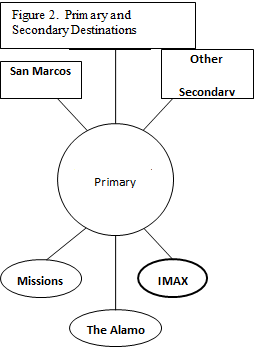
While every destination depends on attractions, services, environmental quality and hospitality, destinations can in the broadest sense be classified in one of two ways, primary or secondary.


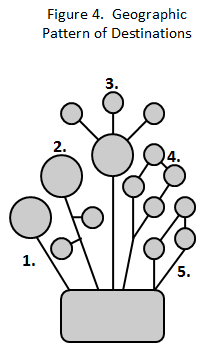
Primary Destinations: are those that have sufficient strength in the mix of attractions and services to justify the “trip” (see Figure 2).  They are capable of attracting and meeting the needs of tourists for the majority of their trip.


Secondary Destinations: meet the needs of tourist in one of two ways:

a) They may be capable of attracting travelers for a side visit as     they are on their way to or from a primary destination.


b) They may be a necessary stop on the way to or from a primary destination.  At these kinds of destinations the services that are available meals gas, accommodations, etc. become the attractions.  These destinations are called travel nodes.


Destination areas can be primary destinations for one travel market segment and secondary destinations for other markets.  


From the traveler's point of view, your community is not just a placeit is a setting in which tourists can have certain experiences and have their needs and wants satisfied.  The attractions, services, environmental conditions, and hospitality within your community shape these experiences.  They represent your community's unique tourism product.  The more opportunity for different experiences available within your community, the greater it’s potential for tourism.  For this reason, many communities team up with other communities nearby in a regional tourism destination approach.


Remember that the key to understanding what your community has that tourists want is to see it through their eyes.  As an old marketing adage (modified for tourism) suggests:  

"To sell Jill Jones what Jill Jones buys you've got to see your destination through Jill Jones' eyes."


The Tourism System


By now we have come to understand three important topics:


1. The market-destination principle.

2. What pushes (motivates) people to travelhow different motives help to understand different travel markets.

3. What pulls people to destinations and provides them with a satisfying visit while there.


This section looks at the two ways that markets and destinations are linked through transportation and communications.  These linkages between markets and destinations complete the functional tourism system.


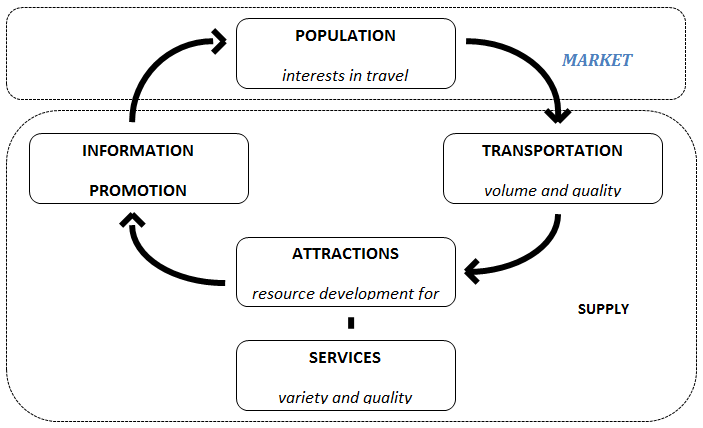
In the tourism system, each element (markets, destinations, transportation, communications) is dependent upon the others.  The system is like a spider's webtouch one part of it and reverberations will be felt throughout.  The following describes transportation and communication linkages between markets and destinations.


Transportation

Transportation physically links markets with destinations.  Automobile, bus, air, and rail are all important modes of travel.  The convenience, safety, reliability, speed, comfort, and price of transportation are important to travelers.  Changes in any one of these factors can greatly influence the flow of markets to destinations.  Transportation is the one part of the tourism system that seems to be particularly volatile in current times.  Changing fuel prices, airline and bus deregulation, and a growing senior market that enjoys coach travel are all trends that affect transportation.


Communication

Communication refers to the flow of information between markets and destinations... between the consumers (travelers) and the suppliers of the tourism experience.  This flow occurs in two directions: 1) from destinations to markets (called promotion); and 2) from markets back to destination (called market research).  This two-way flow of information is essential to the link between markets and destinations.


Promotion

Many people think of promotion only as brochures and other forms of advertisement.  Promotion actually refers to a mix of six primary activities that help to convey information and images about a destination.  Each of the six activities of the promotion mix can be used alone, or in combination by a destination to communicate with the travel markets they want to attract.  These activities include:


1. Advertising:  any paid form of non-personal presentation about a destination that is communicated through mass media.  Leaflets, brochures, newspaper/magazine ads, direct mail, and billboards are forms of advertising.

2. Personal Selling: direct person-to-person communication regarding a destination.  Community members in direct contact with tourists daily can recommend places to eat, sleep, and visit, which is personal selling.

3. Publicity:  non-personal favorable communications in print or broadcast media that appears in news story form.  While many destinations groups and suppliers hope that travel writers will provide favorable publicity, others are proactive in working with writers already producing favorable publicity.

4. Incentives:  items having financial value that are offered to encourage markets to travel to destinations.  Weekend discount rates at hotels, family discounts at attractions, free meals, and two-for-one specials are all incentives designed to encourage travel.

5. Programming refers to the ways that attractions, services, and the atmosphere of a destination are tied together to convey a unique and attractive image that will encourage visitor interest.  For example, communities have grouped their tourism attractions, services, and atmosphere to convey "Old West" adventure or botanical themes.  Proper programming assures that "on-site" visitor information needs are met within the community.  Signage, maps, and guides all help to program and promote destinations.

6. Packaging:  the presentation of products and services that would normally be purchased one at a time.  In a package, multiple products are offered at a single price.  A motor coach tour is an example.


Marketing Research

Marketing research allows consumers to communicate back to managers of destinations.  Simply stated, marketing research means finding out about your markets' characteristics, needs and wants.  In the broadest sense, all communities have two markets: existing markets (those people who already visit the destination) and potential markets (those people who might be encouraged to visit in the future).  For most communities, the greatest opportunities for tourism development are found in existing markets (more will be said about this in Section IV).  For this reason, communities should learn as much as they can about these very important visitors.


There are many ways to conduct marketing research, some more technical than others, but all communities can gather information and feedback from existing tourists in a systematic, simple way15.  Inquiries regarding where visitors are from and how they enjoyed their stay will provide valuable information that will help your community to effectively manage the complete tourism system.


Information gathering techniques that can be used on a regular basis include:


• registration/reservation records at lodging businesses and welcome centers to provide market origin data, visitor profiling, and a basis for sampling

• completed questionnaires on market demographics, service satisfaction, travel habits, and so on

• complaint records and comment cards

• coupon returns and inquiries generated by advertising

• license plate surveys and car counts

• admission records at attractions


Who Is Responsible For The Tourism System?

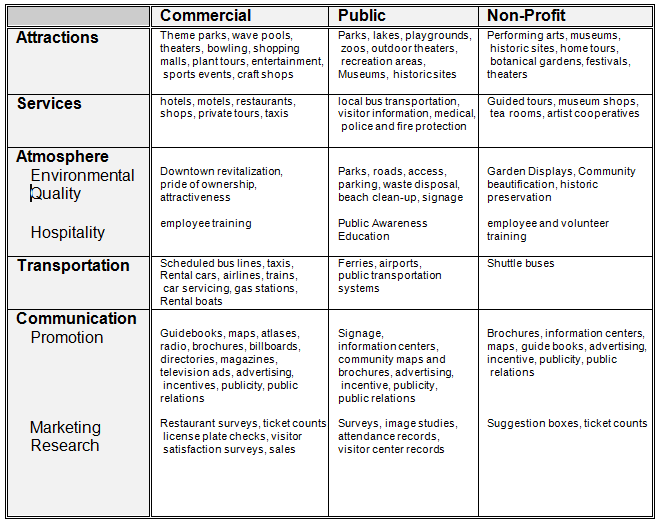
Figure 3 on the following page illustrates the Functioning Tourism System.  From the supply side, many commercial, public, and non-profit decision-makers are responsible for the attractions, services, and other elements of the tourism system.  When we speak of a tourism industry, the statement is only partially true.  The tourism system is not managed solely by the commercial sector as the word industry implies.  Instead, commercial, public, and non-profit sectors all work together to provide the important elements of the tourism system.  Table 1 on page 23 illustrates the range of involvement on the part of each of these sectors.  While each of these sectors may have their own reasons for involvement in tourism, the best overall results are achieved when they recognize and work together to achieve common tourism development goals.  This is the community approach to tourism development.

Figure 3.  The Functioning Tourism System.
(Gunn 1988)

Table 1
Sector Involvement in the Tourism System


Conditions for Effective Tourism Development

As we have seen, tourism is a system of interrelated parts that includes attractions, services, transportation, communications, and markets.  While each of these parts influences all others, certain conditions must be met before the system can operate smoothly and effectively for a given destination area.  These conditions are:

• identification of market niche
• regional cooperation
• community support
• financial support
• leadership and organization
• tourism networking

Identification of Market Niche
Successful tourism depends upon a community's ability to identify its unique selling points and develop a special market niche (target market).  This niche requires identifying and developing a major community theme around which one or more relatively unique tourism products can be developed.  As we have already seen, tourism products are like a basket of goods for visitors to experience.  The more coordinated the items within the basket, the more effective it will be.  Themes such as “family fun," or "history and culture" provide this coordination by creating a tourism image for your community and positioning it in the minds of potential and existing tourists.  Colombian communities have found themes in both natural and cultural resources.  For example, some communities that have strong ties to the production of an agricultural or industrial product have used that uniqueness as a focal point.  Often these themes lead to the development of slogans used in promoting the area.

Before your community begins to plan for tourism it needs to identify existing tourism products and potential opportunities in the surrounding regions and the Colombia as a whole.  The opportunity to develop one-of-a-kind community tourism products based upon the special assets of your community is at the heart of successful tourism.


Regional Cooperation

Sound community tourism development is built upon cooperation not competition among closely situated communities.  Even communities that are recognized tourism sites benefit by linking up their attractions, facilities, and services with those of nearby communities.  This linking up is called clustering.  Clustering occurs when closely situated communities complement each other, with each providing different kinds of amenities for tourists and different facilities that support regional tourism activities.

At first glance, clustering may seem to interfere with a community's ability to establish its own market niche.  The opposite is true however.  Clustering depends upon each community's ability to make a unique contribution to the whole region, that is, the overall tourism image and product.  In this way, clustering creates a critical mass of attractions and services that can attract more tourists and keeps them longer than any one community could alone accomplish.  Regional cooperation is a condition of effective tourism because as the public becomes more discriminating and mobile, they will more likely demand a wider range of quality attractions and amenities before embarking on a trip.

One kind of regional interdependency that is particularly important to smaller communities may be termed the big city-small city relationship.  Certainly, larger cities with different forms of transportation access attractions and services are capable of generating a larger mass of tourism development.  There is no question about the major cities Bogota, ***add Colombian cities being attractive primary destinations on their own.

However, smaller cities accessible from large cities have an important regional interdependency that can enhance tourism for both.  Instead of being negatively competitive, a large city and smaller cities, within reasonable access, can be very helpful to each other by offering a wider range of benefits to market segments.  The larger city can expand its tourism influence by including visits outside its boundaries.  Smaller cities can become important secondary destinations within the large city region, thereby strengthening both citiesa mutual benefit.

All communities, large and small, benefit when tourism increases in their region.  Recognizing this, many have joined together in cooperative efforts to identify and promote regional tourism opportunities and themes.  Cooperative efforts have included: scheduling arrangements to ensure that timing of community special events complement rather than conflict; joint funding of tourism brochures; coop-advertising; and cross-selling.  Cross selling occurs when residents of one community recommend the attractions, services, or facilities of another in an effort to keep visitors within the region.  

For example, visitors that have spent the day at a special event in one community may be directed to a unique restaurant in the neighboring town.

Many communities concerned with tourism have found that these and other cooperative efforts are best achieved through the formation of a regional tourism association.  Perhaps more than anything else, these associations offer opportunities for networking, that is, for meeting and sharing ideas with others equally concerned with tourism's community and regional role.

Community Support
We have already discussed the importance of hospitality to the atmosphere of a community and, hence, its tourism product.  This hospitality does not automatically occur.  It is the result of widespread community support for tourism, and training like that found in the Texas Hospitality program16.  This community support, in turn, is the result of awareness concerning what tourism can and cannot do for a community and the changes it will inevitably cause.  Community support for tourism endeavors can be built by involving local communities in the tourism planning process.  Community leaders must be in agreement as to the direction and the degree of change, which results from the expanded tourism base.  Community leaders who make up a tourism task force should represent those businesses and activities, which provide services and products for tourists.  

The transformation of a community into a tourism destination requires good public relations and educational programs within the community.  These public relations efforts will prevent rumors and will encourage civic involvement and spirit.  Public issues that may unnecessarily polarize the community should be recognized from the start.  These issues may center around social, economic or environmental costs, and benefits of tourism.  For example, a community may choose not to approve higher taxes to support a larger police force, improved water supply, or adequate waste disposal in an effort to develop tourism.  Another community may enact ordinances to protect historic sites from overuse by tourists.  The community may choose to zone for land use that favors development of new businesses or the protection of natural areas.

Tourism can be of great benefit to communities but these benefits are not received without change.  Educational seminars, open forums, and public relations efforts should provide all sectors of a community with an understanding of tourism's benefits and costs.  Political, environmental, religious, cultural, ethnic, and other groups within an area can make or break the development of tourism.  Their interests must be considered and their support secured.  Methods and processes for involving residents and other stakeholders are described in Section IV under visioning and strategic planning.

Financial Support
All tourism development will require financial investment.  In cases where development or improvement of a community's physical resources is necessary, capital costs may be substantial.  In cases where the development of promotional and program resources is the focus, fewer financial resources may be required.  Financial resources for projects that assist with tourism come from many sources, such as private foundations, development funds, grants-in-aid, hotel/motel taxes, special fund-raising events, bonds, lending institutions, and private investors.

The ability of investors and financial institutions to understand and support tourism is paramount to its success.  Unfortunately, tourism as a form of economic development is often difficult to visualize.  Because tourism does not represent a single economic activity but a compilation of many (attractions, transportation, entertainment, retail, lodging) it is often difficult to define just what is being financed for tourism.  Furthermore, tourism related many financiers as high risk see investments.  Seasonality and lack of accurate feasibility information on tourist facilities contribute to this low confidence.  Nevertheless, statistics suggest that tourism is a particularly resilient economic activity even during periods of economic recession.  Additionally, in the 1990 to 2010 the growth for tourism related jobs has outpaced that of every other industry. 

Tourism development dreams cost money.  Visions of tourism grandeur must be tempered with the realization that money must be available to complete the first projects before tourists arrive.  For most communities, incremental growth that builds one success upon another is the best way to develop a comprehensive tourism program.


Leadership 

Competent, motivated leadership is the key to shaping human, physical, and financial resources into a coordinated tourism development strategy.  No matter how available the attractions, services, facilities, or finances are, no tourism program successfully reaches its potential without sound leadership.  Remember too, tourism must be incorporated into the overall plan of the community.

Who provides tourism leadership?  In many communities, tourism development efforts are initially led by an existing organization, an arm of the chamber of commerce, an economic development group, a convention and visitor bureau, a hotel/motel, restaurant, or retail association.  The support of organizations that are already serving visitors is essential since they already have a great deal of "hands on" expertise.  Whether one of these organizations assumes leadership or not, their participation should be guaranteed before tourism development efforts start.  In the same way, tourism should not be planned separate from other community development efforts.

Entrepreneurs who can visualize opportunity, and capitalize on it, also provide tourism leadership, particularly for the commercial sector.  Many tourism development plans never materialize because the right people do not take advantage of the opportunities.  The ability to identify tourist’s needs, obtain the right location and site, engage designers to create the appropriate structure, and gather together the right human resources to manage the investment is a special kind of leadership, and one that is essential to tourism development.  The public sector can encourage entrepreneurial leadership by providing a favorable regulatory climate for launching ideas into action.

Whatever the source of leadership, an organization, or a group of entrepreneurs, that leadership must consider diverse public support in its efforts to initiate and sustain community interests.  Tourism is indeed a community affair.  As the scope of tourism development efforts broadens, leadership must also expand to reflect the many community “stakeholders” who contribute to the tourism product.  Because of the vital role of leadership to any successful tourism development effort, Section IV will provide suggestions for creating a tourism task force that advances tourism interests and action plans at local and regional levels.  Now that you understand what tourism is all about, it’s time to examine if it is indeed your community’s best economic development alternative.

 
Tourism Networking
Sound tourism leadership depends upon networking.  Networking means linking up with other “stakeholders” involved with tourism to coordinate efforts, share ideas and approaches, and learn from the experience and perspectives of others.  Networking is vital to effective tourism development and should occur at all levels: community, regional, state, and national/international.  When there are two or more parties working for tourism, networking can and should occur.

Community Networking
Networking is important from an individual, enterprise, and agency perspective.  We have already seen the variety of commercial, public, and non-profit stakeholders involved with the delivery of tourism opportunities within a single community.  Local traffic, health, and police departments can develop better policies and operate more effectively if they coordinate with lodging, food service, entertainment, and other tourism commercial interests.  Developers and entrepreneurs can produce better visitor services if their relationships with political governmental agencies are proactive rather than reactive.  Business activities that are well integrated with other elements of the tourism system (attractions, services, and transportation) can be better promoted.  Every tourist business, every non-profit group, and every public agency involved with tourism can benefit, and can help tourism within the community benefit by networking with all other community interests.

Regional Networking
We have discussed the importance of regional cooperation to tourism development efforts.  This cooperation requires combining promotion efforts, exchanging ideas and sharing expertise.  How can you begin networking within your region?  If your community falls within the sphere of influence of a larger destination (a major primary destination) you can begin by contacting the chamber of commerce or convention and visitors bureau there.  Those working in tourism in major primary destinations recognize the importance of their surrounding communities and are often eager to provide technical assistance and advice.  Regionally, many communities are recognizing their collective wisdom and strengths and are establishing regional associations.  Some of these associations sponsor newsletters and meetings to facilitate the networking process.  There are a number of regional tourism associations in Colombia

 
Statewide Networking
On the state level there are a number of public agencies and non-profit agencies that can provide technical assistance and advice relevant to tourism.  Several government agencies are primarily responsible for tourism marketing statewide.

Here we need to gather the information about Colombia organizations.

Texas Department of Economic Development, Division of Tourism: is dedicated to promoting Texas in the national and international tourism areas.  The Tourism Division works with public and private sectors to increase cooperative relationships to expand tourism in Texas.  The Texas Department of Economic Development developed the theme: Texas.  It’s Like a Whole Other Country.  ®  The Tourism Division is responsible for marketing, research and tourism development, and travel trade of Texas.

Texas Department of Economic Development, Trade and Investment Division: is dedicated to overseeing programs aimed at retaining and expanding the state’s existing business and industrial base while marketing Texas globally as an ideal spot for locating or expanding a company.  The primary objective’s of the Trade and Investment Division is to increase marketing efforts with an emphasis on international opportunities; to position the agency as a clearinghouse of economic development information for all Texas communities and businesses; to make Texas business globally competitive through improved technology, worker training, and accompanying capital investment, and to increase economic opportunity for small communities.

Texas Department of Transportation, Travel And Information Division: operates the 12 Travel Information Centers at major entrances to Texas, as well as it publishes and/or disseminates literature including Texas Highways and the Texas State Travel Guide.  The department also answers the 1-800 information number supplying information about points of interest and road conditions.  

Texas Parks And Wildlife Department: is the primary state agency charged by the legislature to provide visitors and Texans with opportunities to experience Texas’ natural and cultural resources by operating and maintaining a system of State parks and State Wildlife Management Areas; monitoring, preserving, and enhancing the quality of lakes, rivers, streams, public and private lands, coastal marshes, bays, beaches, and Gulf waters; and assisting public and private entities in providing quality outdoor recreational opportunities.

Texas Historical Commission: is the official state agency for historic preservation, encouraging the restoration and development of landmarks, historic structures, archaeological sites, and museum collections so visitors may experience the unique heritage of Texas.  The agency administers a historical marker program; coordinates the work of local heritage organizations; and coordinates the Texas Main Street Program.

Many public and private non-profit associations such as the Texas Travel Industry Association, Texas Festivals & Events Association, Texas Nature Tourism Association and Texas Travel Research Association are integral players in the state tourism network.  Additionally, there are several Texas licensing/regulatory agencies that are empowered to issue permits or licenses, or to impose standards for the operation of a particular area of jurisdiction.  A listing of these associations and agencies is also provided in the Sources of Assistance for Tourism in Texas publication.

National and International Networking
Seemingly far-removed from the community level are those organizations with national and international level tourism interests.  However, these organizations often represent the headquarters-office for a number of national/international professional and trade associations.  Here, a wealth of industry-specific statistics is collected on a national level by associations and research organizations.  The resulting publications, which present such information, are useful in describing market information and trends, and in providing directories of members; which are useful in facilitating additional networking.  National organizations are also effective clearinghouses for information about a specific segment of the tourism industry and in promoting the cause of its membership and their interests.  Members are frequently offered educational programs and conferences, which help to maintain and upgrade their professionalism.

Networking At Any Level

Community, regional, state, national and international networking requires cooperation in tourism planning, development, and marketing efforts.  This cooperation leads to stronger tourism leadership throughout the many communities and regions of Colombia and consequently, benefits all. 

Section III


Do You want More Tourism?

Every community that has some form of retail business very likely already has tourism.  Throughout Colombia many communities have developed economies around the activities and needs of the traveling public.  Others have chosen to develop tourism alongside other economic endeavors to create a more diversified economic base.  Still other communities throughout Colombia have the potential to develop tourism as a primary or secondary economic activity.

Tourism has been shown to deliver a chain of economic, social, and often environmental benefits to communities that thoughtfully and successfully develop it.  It is not developed, however, without some costs.  The decision to launch a tourism program should be made only after the community’s unique economic and social needs are defined.  Tourism then, should be considered as one strategy among others to achieve the community’s desired goals.  To make this decision, a community should evaluate:

• Community needs that tourism could meet,
• The trade-off between the benefits that tourism delivers and the costs and liabilities it imposes, and
• Community interest in tourism.


Assessing Community Needs

All communities have economic, social and environmental needs.  Many of these can be addressed by developing the local economy.  The following are some of the positive contributions that tourism development often makes to communities.

• brings in new money
• supports small businesses and creates new jobs
• diversifies the economic base
• generates tax revenues
• enhances the community’s image
• helps provide attractions and services that may not otherwise be viable without tourists

Benefits Of Tourism
Tourism Brings In New Money
Tourism is an export business that exports customer or visitor satisfactions in exchange for new, outside dollars.  The final effect of these new dollars that enter the community from the outside is not limited to the initial economic activity and exchange.  The degree of additional impact is a function of how long the new dollars remain in the community, in terms of the number of exchanges and transactions they enter into.  When those imported dollars leave the community to purchase or import commodities or services from outside the community, their local impact ceases.  Other things equal, the larger and more complex the community economy, the longer the imported dollar will remain before leaking out, and the greater the impact.  This additional activity is referred to as the multiplier.  

When a traveler buys gasoline in a small service station in a rural community, most of that gross income to the operator may leave the community directly to purchase more gasoline from a wholesaler outside the community.  What is left in the hands of the service station operator may even then move quickly out of the community.  The multiplier, in this case, will be low.

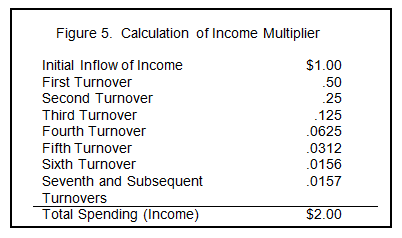
While very small communities or communities with simple, narrow-based economies may have multipliers approaching 1.0, very large communities with broad economic bases may have multipliers approaching 3.0 or 4.0.  The following example17 in Figure 5 below will explain the income multiplier in more detail.  In this example the multiplier is 2.0.  Caution should be used since multipliers are abstract thereby making it difficult to justify their actual impact.  Multipliers do give an idea of the impact that tourists’ dollars have on a local economy.
Calculation using the formula: Income Multiplier = 1/1-X = 1/1-.  5 = 1/.  5 = 2
Tourism Creates Jobs
Tourism is a service industry requiring large numbers of employees in relation to the amount of investment.  While more and more professional positions in tourism are emerging, many jobs created by tourism require only moderate education and skills.  Because of the seasonal nature of tourism, part-time jobs are made available for the underemployed, including retirees.  In many communities, the tourism season coincides with school vacations, providing employment opportunities for area youth and the necessary labor for successful tourism operations.  Careful analysis of a community’s labor situation must precede tourism development efforts.

Tourism Supports Small Business
Small businesses dominate the tourist/travel industry.  In small and medium-sized communities, these businesses employ local people, encourage economic diversity and stability, and help to increase the economic spin-off of tourism by keeping tourism dollars within the community.  Frequently, “cottage industries” are nurtured by tourism such as artisans making pottery, tapestries, paintings and carvings, or bed and breakfast businesses, and other local entrepreneurial efforts.  Tourism’s support of small business means that it can truly be a community affair, with local residents able to engage in small business development.

Tourism Attracts Other Industry
Irrespective of a community’s size, economic diversity is a key ingredient of stability because it serves to level out peaks and valleys of the earnings of local industry.  Beyond the diversity of businesses and industries inherent to tourism, the amenities often associated with tourism activity in a community can be an important attraction to businesses seeking places to relocate.

Why is this?  Most modern businesses are involved with travel outside their home community and with housing visitors in their own environment.  Travel access and services are important considerations in business relocation decisions.  Recent studies have also shown that businesses prefer to locate and operate in high-amenity areas.  A community that maintains a high quality resource base and offers outstanding services in order to generate tourism may also find that it is attractive as a location for manufacturing trade, and other industries.

Tourism Enhances Community Image and Pride
Many communities experience an image problem even among resident populations.  Tourism development requires that a community examines its resources from a visitor’s perspective and discovers its special qualities and problems.  By playing host to tourists, residents often gain a heightened sense of pride and interest in their community.  This in turn makes the community even more attractive as a place to live, work, and visit.

Tourism Helps Support Community Amenities
Tourist expenditures are valuable revenue sources for community facilities such as theaters, sports facilities, shopping centers, food services, and entertainment.  In small communities revenue generated by local use alone is often not sufficient to keep these kinds of facilities operational.  Tourists’ support of them often provides the critical difference needed to maintain amenities to the benefit of both tourists and residents alike.

Tourism Can Promote Conservation And Preservation
Those things that are unique to an area and community, such as cultural heritage, architecture, scenery, and natural resources attract visitors.  An awareness of the value of these resources to tourism can motivate communities to develop management programs for conserving and protecting them.  Some communities with special heritage have been motivated by tourism to preserve unique artisan techniques that might have otherwise been forgotten.  

Others have been motivated to restore historic districts that are important tourism “attractors” and community amenities.

Worksheet 1a will help you assess your community’s needs and tourism’s possibility for addressing them.  The left column lists needs in the three categories: economic, social/cultural, and physical environment.  The center column provides space for your own assessment of your community’s situation concerning these needs.  The right column suggests the role that tourism might play.

Once you have completed this worksheet you will have a clearer understanding of your community’s needs and the ability of tourism development to address them.  Tourism is one of many forms of economic development.  It may or may not be the best alternative for your community or it may be successful only if it is developed alongside other economic development efforts.  Each community’s unique situation must be considered before launching into tourism development action.


[PLEASE COMPLETE WORKSHEET 1A]

 
Considering the Trade-Off of Benefits and Costs

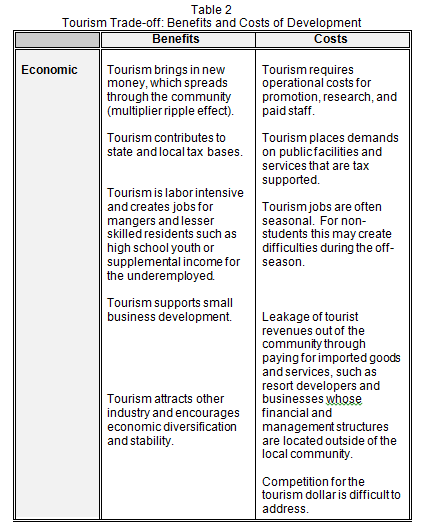
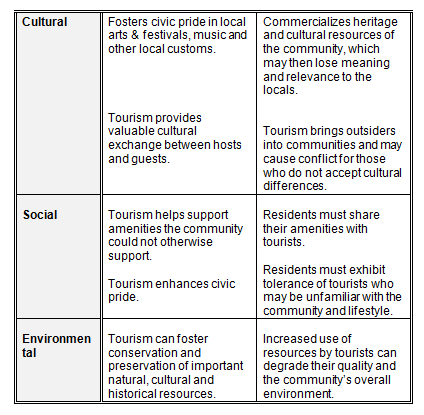
While tourism delivers many benefits, it also imposes costs and liabilities.  Those that are most commonly encountered are described in Table 2.  Recognizing only the benefits of tourism leads to shallow development and false hopes.  Table 2 summarizes the trade-off between tourism’s benefits and the costs that must be considered when community tourism development is in question.  All may not be relevant to every community and most can be addressed through proper tourism planning and management.  Worksheet 1b will help you assess your community’s capacity to absorb the costs of tourism. 

Costs Of Tourism

Tourism May Conflict With Resident Use Demands on Public Services and Facilities
Tourism development places increased demand on the need for public facilities and services including: roads, parking, informational signs, promotion, park and recreation areas, water supply, sewage and trash disposal, restrooms, public health and welfare, and public safety such as police and fire protection.  Because these facilities and services are primarily supported by local taxes, increased demand will likely affect residents’ property tax rates.  For example, some coastal communities in Colombia have found that the tourism demands on beach cleanup, maintenance, and security represent a substantial tax burden.  However, many communities have found that tax revenues generated by tourism offset these increased public costs.  Others have instituted use fees at public sites, such as beaches, to further balance the trade-off of tax costs and benefits.

Tourism Requires Operational And Capital Costs
Operational costs are increasingly encountered as a tourism program grows in size and stature.  These costs, which are essential and inevitable for successful tourism development, include promotion, market research, fund-raising, association memberships, and the support of paid tourism staff.

Tourism Brings Strangers Into Communities Whose Activities May Conflict With Those Of Residents
When evaluating tourism development it is important to consider community values.  Activities of tourists may conflict with the lifestyles and mores of local residents.  For example, some residents may view gambling or paramutual betting as important tourism “attractors,” yet others may be offended by such leisure pursuits.  Residents may also find that as tourism develops they must compete with visitors for use of local facilities and services such as roads, parking, food services, and local attractions.  Conflict between tourist’s needs and residents’ life styles can erode a critical foundation of successful tourism, which is widespread community support and hospitality.

In Some Communities A Tourism Industry Versus Rest Of The Community Feeling Develops Into Antagonism
Because businesses that serve tourists are often the most visible element of tourism within a community, many residents may perceive only one sector of the community, the private sector, benefiting from tourism.  This usually results from a lack of understanding of tourism goals and objectives.  Tourism can support and be consistent with many local economic and social goals.  As a composite industry requiring support from public, private and non-profit sectors, tourism cannot be singled out as benefiting and being the responsibility of profit-oriented businesses only.  Awareness programs and regulated tourism growth can minimize these problems.  Tourism awareness programs and regulating tourism growth can help address some these problems.  Disseminating information to residents about tourism, it’s characteristics, it’s positive and negative impacts, etc., is important in order to ensure that they are informed and prepared for dealing with tourism in your community.  Such tourism education can be conducted through local media such as community newsletter / newspapers, local television and radio, direct mail-outs of information, as well as workshops and public information sessions.

Tourism Is Often Seasonal
The seasonal nature of some segments of the tourism industry can cause problems in supporting capital investments in tourism development, whether public or private.  The challenge of seasonality can be addressed in part by using special marketing strategies to encourage travel during the off-season.  For example, many communities to extend their tourism season have used conducting special events during slower periods.  Unfortunately, the development of new tourism products to attract new markets during slower seasons of the year has been used more by individual tourism resorts and businesses than on a coordinated community-wide basis.

Year-round outdoor recreation potential and idyllic vacation weather during spring and fall periods suggest great opportunities for extending the tourist season.  Furthermore, growing travel segments, such as the senior market, are not restricted to structured vacation times, as are family travel markets that need to accommodate school children.

People-Pressure On Local Resources And Services May Cause Environmental Deterioration And Pollution
Overcrowding and inadequate support facilities pose a problem for natural resources and some public services.  Resource protection and environmental quality are community-wide and sometimes controversial issues.  Active involvement of local government in tourism planning can help anticipate and alleviate overcrowding and environmental deterioration, but this requires a long range outlook and broad perspective of tourism.  Because tourism is often developed around natural attractions, this long-range outlook is essential for ongoing tourism success.  When planning for tourism, it is important to identify and develop ways of maintaining and preserving natural resources and other unique community assets that are important to residents and visitors.

 [PLEASE COMPLETE WORKSHEET 1B]


Assessing Community Interest in Tourism

Tourism, perhaps more than any other form of economic development, depends upon community-wide interest and support.  Because tourism requires that residents play host to visiting guests, their willingness to serve in this capacity and join in tourism efforts must be carefully assessed.

Community interest can be assessed by:
• holding public meetings
• conferring with key community representatives
• conducting surveys
• soliciting written responses from citizens
• visiting with community interest groups
• determining community values
• office / home meetings
• informal communications on the street or in other public spaces

As you evaluate community interest, consider also what residents know about tourism.  A community education program explaining the balance of tourism costs and benefits may be instrumental to pique residents’ interest, address their concerns, and secure their ongoing support.  Research studies demonstrate that residents who perceive positive economic impacts from tourism tend to be more favorable towards tourism development than those who do not see personal gains to be made from tourism.  Other studies demonstrate that the more informed the residents are about tourism and tourism development in their community, the better they are able to make informed decisions about tourism related proposals and plans.  A resident population that is educated and knowledgeable about various facets of tourism is an asset, for it enhances community capacity, and stands a better chance of dealing constructively with tourism impacts.

Once community needs, tourism’s benefits and costs, and community interest have been evaluated you will be ready to decide to what extent tourism is a sound development option.  While some communities have superior endowments that allow tourism to be the focal point of economic activity, most communities will find that their goals are best achieved when tourism is one part of an overall development plan.  This plan may include choosing several forms of complementary economic development activities to meet the community needs that any one industry may not alone address.  

The next section describes a tourism planning process that helps to convert ideas into a tourism action plan.  Worksheets are provided to assist you in applying the steps of the process to your own community.


SECTION IV


HOW ARE TOURISM INITIATIVES DEVELOPED?


By now you have come to understand:

• Tourism’s role as a growth industry in the Colombia,
• Definitions of tourism and tourists,
• Ways to understand travel markets and destinations,
• How the tourism system functions and conditions for making it work smoothly,
• Benefits and costs of tourism development, and
• Methods of assessing tourism as a sound development alternative for your community.

If you have decided in favor of more tourism in your community then you are ready to begin planning for its development.  Successful tourism development depends upon five factors:

1. Attracting appropriate visitors to your destination area (i.e. community and surrounding region).
2. Providing tourists with a satisfying experience that meets (better yet, exceeds) their expectations.  This will result in repeat visits and positive “word of mouth” promotion.  Because word of mouth is considered one of the most effective forms of promotion, this last point cannot be overstated.
3. Keeping tourists in your destination area for as long as possible.
4. Satisfying the needs and concerns of local residents by involving them in directing, controlling and providing the tourist services and experiences.  Local control over tourism development is critical if tourism growth is to be sustainable with respect to local resources.
5. Ensuring leadership, organizing and planning for sustainable tourism development, with a perspective adopted from a community-based vision of how it wishes to evolve over the medium to long-term.

Attracting, satisfying, and keeping tourists does not just happen.  It is the result of careful tourism planningplanning that builds on a community’s unique features with certain travel markets in mind.  It is also the result of committed leadership and organizing tourism in the community.  This leadership helps to ensure that the conditions for effective tourism development (regional cooperation, financial support, and community support and involvement) are continually in place.  You have already discussed the importance of leadership as a fifth condition for effective tourism.  This section begins by focusing on ways tourism leadership can be encouraged at the community level through the formation of a tourism task force.  Steps explaining the tourism planning process that will help to turn tourism ideas into action are presented.  Worksheets are provided to help apply these steps to your own community.


Organizing and Leadership for Community Tourism

No vision of community tourism development has ever been realized without leadership.  Typically, a special interest group first spearheads tourism interests.  In Colombia, these groups have included business associations, chambers of commerce, historical societies, economic development commissions, attraction associations, local government officials, and groups of concerned citizens.  Indeed, you are very likely a member of one or more such interest groups!

Groups that provide leadership in initial tourism efforts are critical to getting the ball rolling.  Often, they possess a great deal of hands-on expertise related to tourism and have an understanding of those travel markets your community is already serving.  While special interest groups provide the much-needed initial thrust for tourism, longer-term tourism development efforts are best achieved if local leadership represents the broad range of community stakeholders and interests that are important to the delivery of the tourism product.  As you have already seen, tourism is a community affair.  One vehicle that is successfully used by many communities to ensure a broad leadership base is a tourism task force.

Note that a tourism task force is only one way of organizing leadership in the tourism development process.  Other organizations may be called upon or formed to assume leadership for tourism development and marketing.  For instance, in a small community where tourism is too small a component to merit having a Convention and Visitors Bureau, the Chamber of Commerce or Economic Development often manages tourism related issues and can be called upon to lead the tourism process until a specific tourism organization is formed.

What Is A Tourism Task Force?
A tourism task force is a formal association responsible for initiating, planning, and evaluating tourism within your community on an ongoing basis.  Tourism task forces may vary considerably from one place to another.  Often they are housed within existing organizations, such as chambers of commerce or historical societies.  In the early stages of tourism development, the director and other key players are likely to be volunteers.  As tourism expands within the community, these functions may become the responsibility of a professional tourism staff.

What Are the Advantages of A Tourism Task Force?
• As an association of community representatives, the tourism task force helps evaluate the costs and benefits of tourism for different sectors of the economy (i.e. commercial, public, non-profit).
• The task force ensures that a wide range of ideas and interests of community groups, as well as the general public, are considered in the tourism planning process.
• The task force helps keep the community informed about new tourism initiatives.  Each member communicates with the groups he or she can most effectively reach.  This helps to educate the public.
• The task force helps community members to work together to adopt a community approach to tourism development.
• The task force assumes responsibility for identifying tourism goals, coordinating tourism interests, and launching them into appropriate action.

Who should serve On the Tourism Task Force?
Typically, a task force is best served by 9 to 12 community members who are:

• recognized and respected leaders in the community that potentially represent all sectors of the local communities
• work well with others and have a high level of commitment to community development efforts
• have sufficient time and resources to commit to the project

 
You know that tourism is not the responsibility of a single community group, or even a single sector of the economy.  Members of a task force should, therefore, represent commercial, public, and non-profit sectors, as well as the general public.  Within your own community, certain organizations, such as a retail association, may already be aware of their tourism role.  Others, such as an agricultural association that organizes an annual fair, may already be contributing to tourism without realizing it.  These and other groups may provide the leadership essential to a tourism task force within your community.

What Does A Tourism Task Force Do?
By now you have assessed the benefits and costs of tourism and its position within your economic development plan.  If you are proceeding with development you should have a clear understanding of the community needs that tourism development can enhance.

Before embarking on tourism development, the initial job of the task force is to identify and prioritize the underlying goals of these efforts.  For example: 

• Is tourism primarily a vehicle for increasing revenues, tax base, and/or employment?
• Is tourism primarily a way to generate interest and revenues necessary to support historic preservation?
• Is tourism a vehicle for creating a new community image, attracting other industries, and promoting economic diversification?

While tourism development will likely deliver a variety of benefits, agreement by members of the task force upon the primary goals tourism is designed to accomplish will provide the focus necessary to shape subsequent planning and development efforts.

What Is Involved In Tourism Planning and Development?
A great many tasks and responsibilities are included in the framework of the tourism planning process discussed in detail on the following pages.  First, look at some of the tasks your community’s tourism task force may need to undertake:

Community Education: responsible for improving community awareness and appreciation of tourism by educating residents about their community assets so they can be effective ambassadors.

Business Expansion: responsible for identifying and generating opportunities to develop or improve tourism services.

Regulation Research: responsible for communicating with legislators and other public officials regarding government and legal regulations that will affect tourism.

Community Beautification: responsible for identifying community beautification projects that improve environmental quality, such as those that focus on community entrances and downtown areas.  These projects often represent ideal service opportunities for local groups such as garden clubs, youth groups and historical societies.

Hospitality Training: responsible for identifying ways to improve hospitality extended by both front-line and back-stage employees.  (See Solomon Source Hospitality Program)

Promotion:  responsible for promoting the community and region’s tourism resources to target markets.

Marketing Research: responsible for collecting information about existing and potential markets, and forwarding recommendations regarding target markets.

Regional Cooperation: responsible for working with representatives of neighboring cities and towns to ensure that regional tourism objectives are advanced.  Working regionally is part of networking; sharing ideas and information with others to the benefit of all.

Evaluation:  responsible for identifying criteria for evaluating individual program effectiveness and overall tourism impact.


The Tourism Planning Process

With committed tourism leadership in place, goals prioritized, and tasks acknowledged, your community is ready to begin assessing, developing, and promoting its special tourism opportunities.  The process of tourism assessment and development is called the tourism planning process.  Basically, the tourism planning process addresses four questions:
1.  Where are we now?  
• This is covered by the community analysis and the market analyses.

2.  Where would we like to be?  
• This requires the development of a community-based tourism vision and direction, as well as, identify tourism development goals and broad strategies for each goal.

3.  How will we get there?  
• This is determined by setting specific objectives and action plans to achieve the goals, strategies and vision identified in step 2.

4.  How will we know when we get there?  
• This is covered by your evaluation of tourism results, as well as a monitoring plan that enables you to set and measure performance standards and indicators, as well as adjust various parts of the overall plan based on ongoing monitoring and evaluation.

Tourism planning is not a one-time effort.  It is an ongoing process where planning is dynamic and iterative rather than sequential and linear.  This fits with the characteristics of tourism as a high dynamic system of interrelated parts. A change in any one factor, such as your tourism attractions, will likely affect all other elements of tourism in your community-services, promotion, and transportation.  Likewise, turnover in leadership of business, government, and non-profit organizations suggest ideas, assets, and visitors will change as leaders change.  

There are five steps to this tourism planning process (refer to the corresponding worksheets for guidance):

1. community analysis
2. market analysis
3. create a vision statement and identify tourism goals and broad strategies
4. establish specific objectives and action plans
5. monitor, evaluate and adjust various aspects of the above as required.

BACK TO COURSE CONTENT

This free website was made using Yola.

No HTML skills required. Build your website in minutes.

Go to www.yola.com and sign up today!

Make a free website with Yola